
Ask about any product. The answer cites its sources.
CARA profiles each product from its docs, Docket cards, and Gavel decisions, checks every quote against its source, and answers planning questions with numbered, clickable citations.

Internal to Renkara. CARA is a tool Renkara Media Group builds and runs for itself. It is not for sale, and there is nothing to buy or join.
A planning partner that shows where it got each claim.
CARA keeps a registry of products, builds a profile for each from the product's own record, and answers questions in a streamed conversation that cites the profile's numbered claims. It runs locally today. These are the things it does.
Talk it through, with the receipts
Streamed answers
Replies stream in as Claude Opus 5.5 writes them. A turn runs as its own task, so the reply and its cost are saved even if you close the tab, and an error says whether your message was saved.
It knows the portfolio
The advisor gets a one-line index of every product, plus the full profile of up to four products your latest messages name. It has no tools: it cannot browse, fetch, or read a repository live, and it is told to say so.
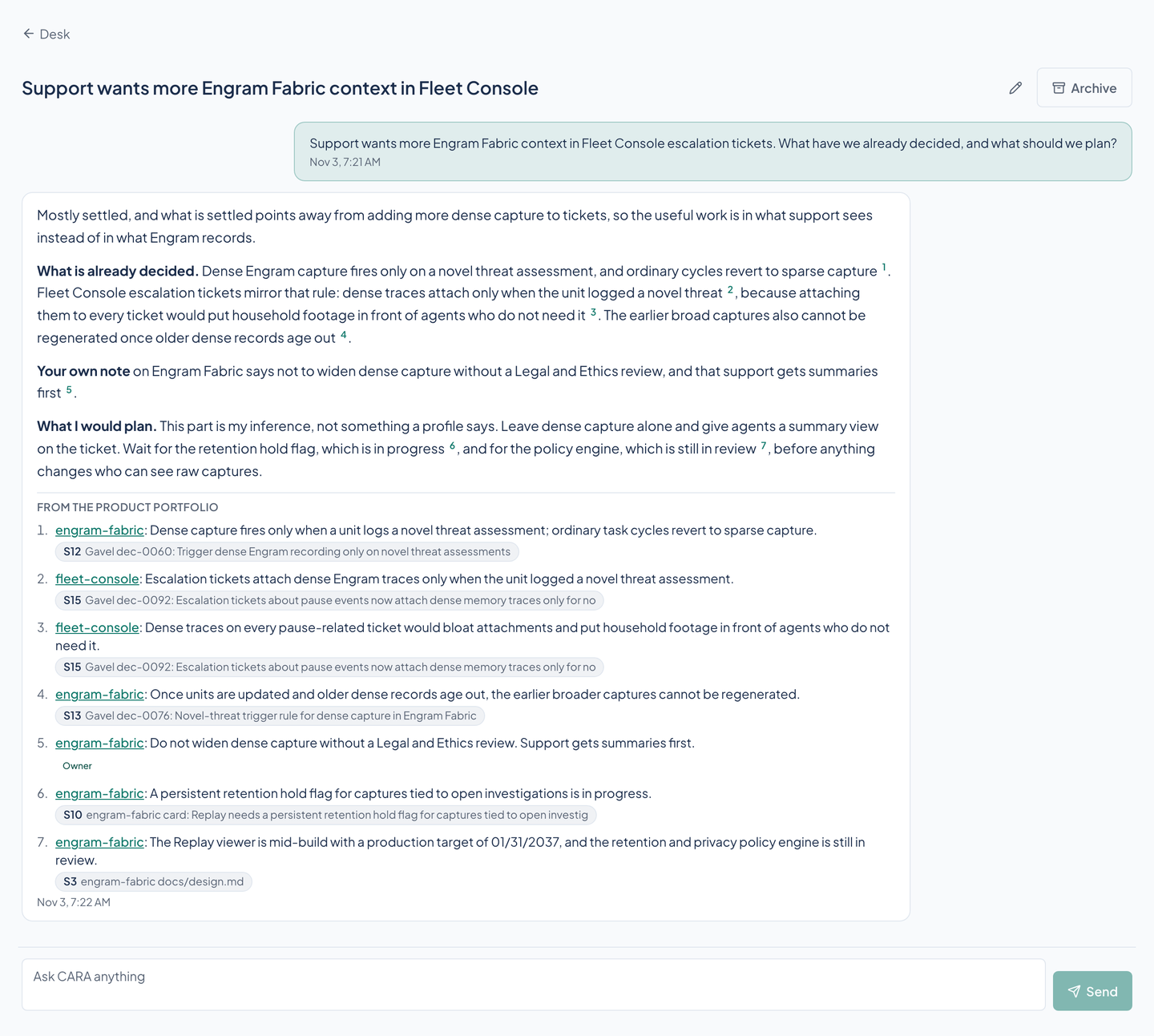
Claims arrive by number
When the answer leans on a profile claim, it writes a marker such as [engram-fabric:4]. CARA turns each marker into a numbered entry under the reply: the product, the claim, the source it cites, and an Owner badge when the claim is your own words. A marker that names no real claim gets no entry.
It says when it has nothing
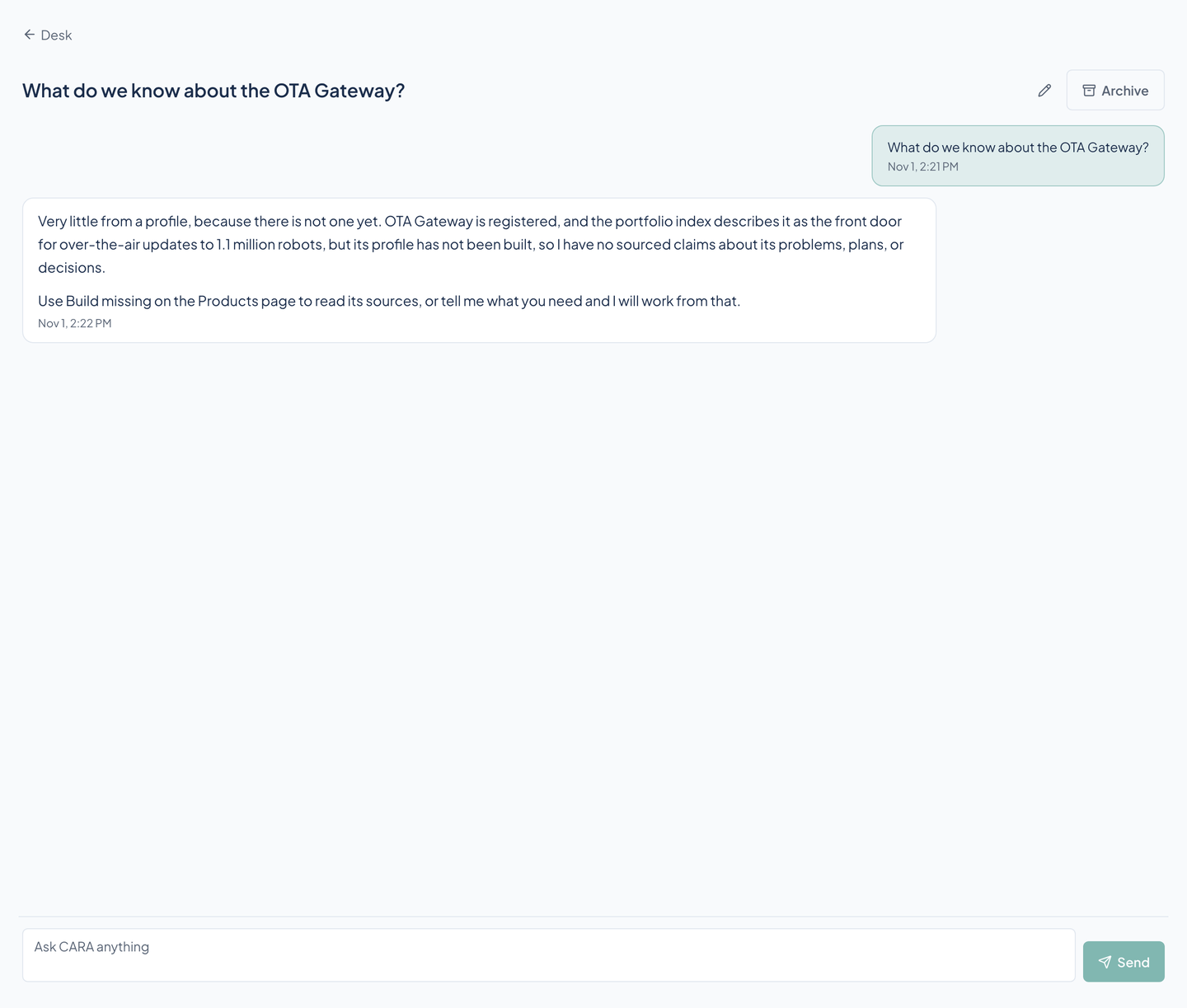
Ask about a product with no profile and the answer says so and cites nothing, instead of guessing from the product's name.
Threads you can find again
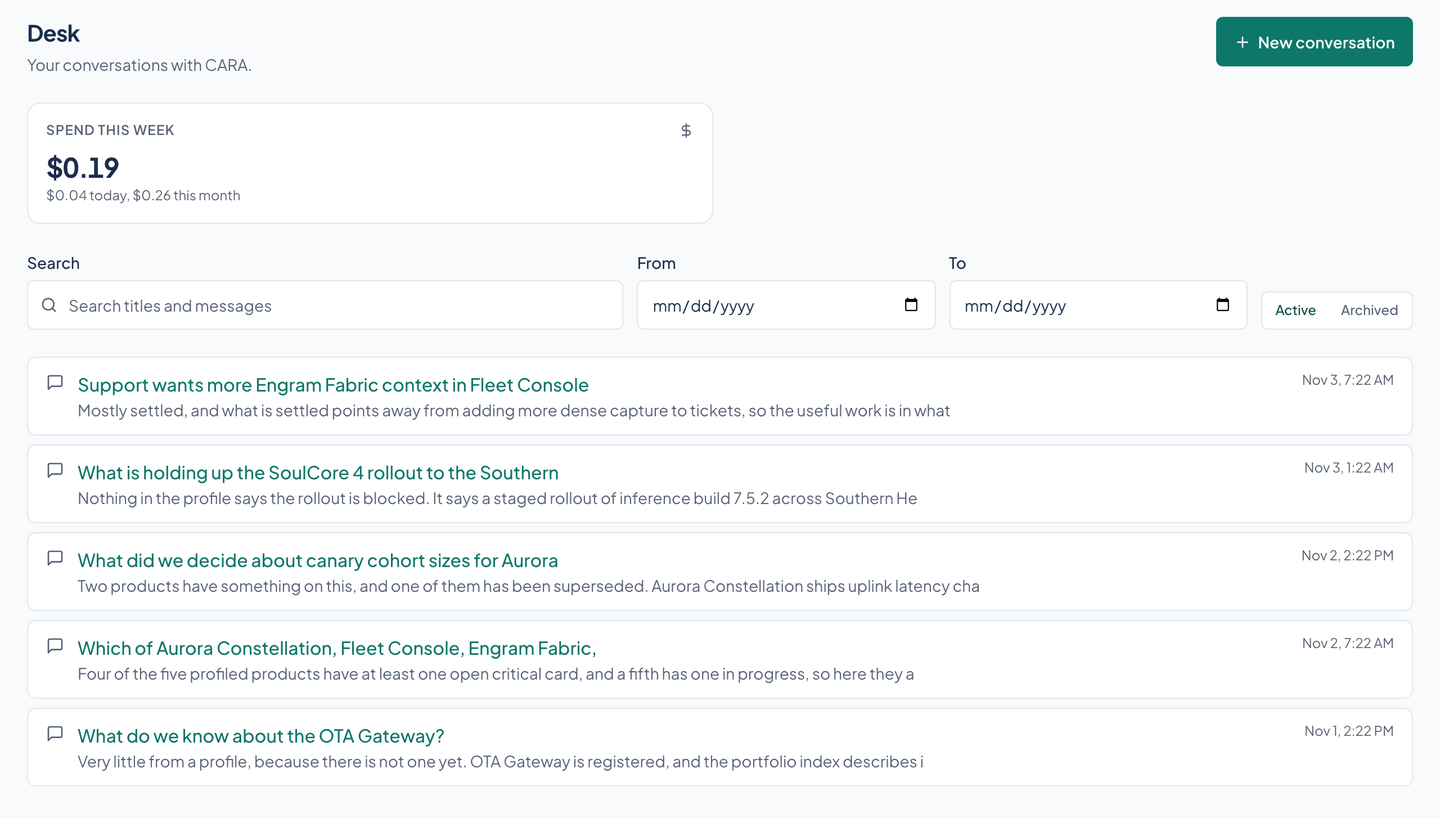
A conversation takes its title from the first message. Rename it, archive it, or search titles and message text with a date range.
Spend you can see
Every model call is recorded from the usage the API reports. The Desk shows spend today, this week, and this month, and a turn that would start at or over the daily cap of $20 is refused instead of run.
A profile for every product, built from its own record
One registry
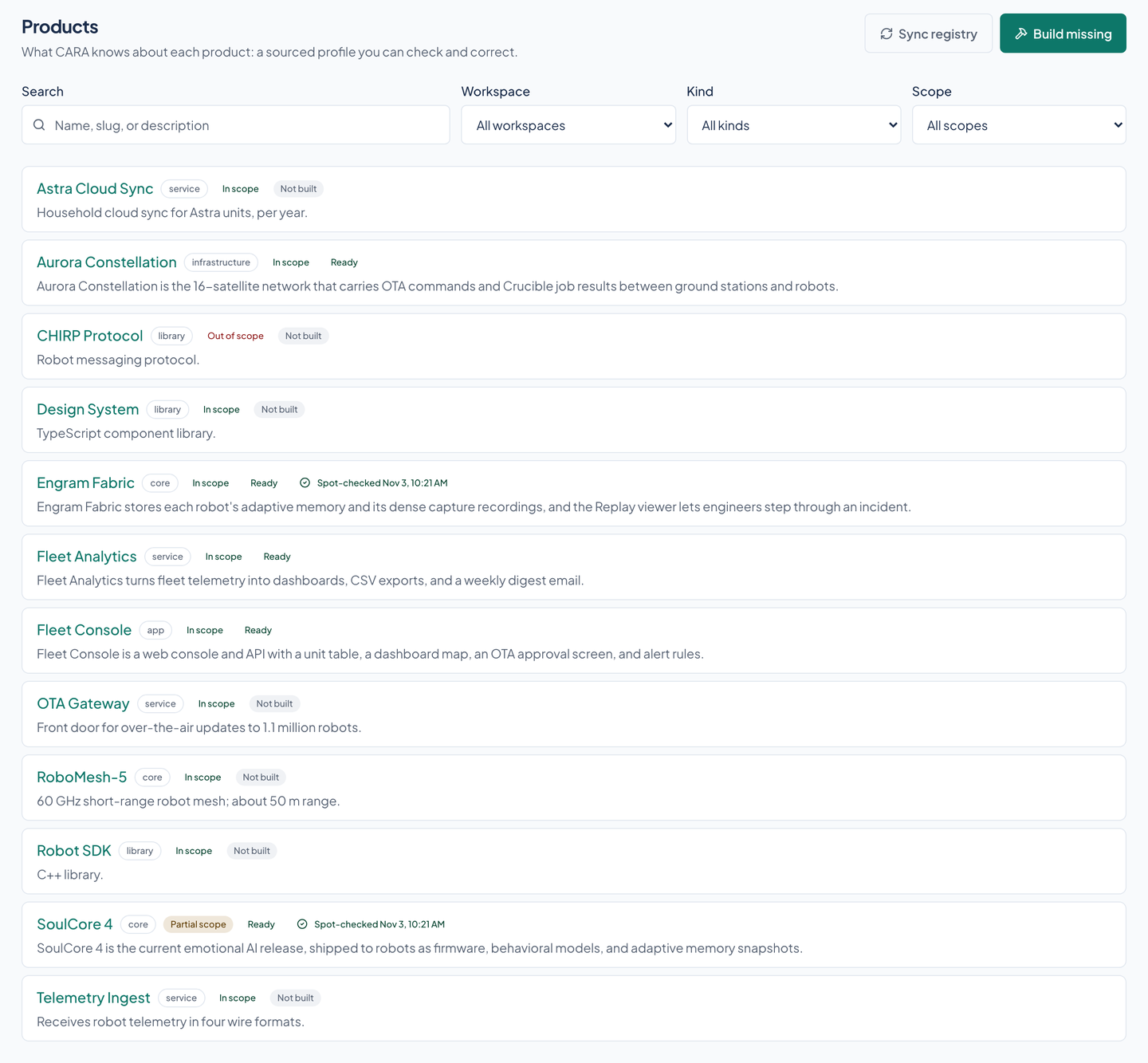
Products are read from two repository maps, one per workspace, and synced on request. Each has a kind, its repositories with their roles, and a Docket board, found by name or pinned by you. Filter by workspace, kind, or scope.
A profile from three sources
Claude Sonnet 5.5 condenses the product's README, requirements, design, and plan, the open cards on its Docket board and those closed in the last 90 days (up to 60), and the Gavel decisions that name its repository (up to 40). The profile has a summary, users, phase, capabilities, open problems, planned work, what was decided against, and constraints, with at most eight claims in a list.
Every cite checked by machine
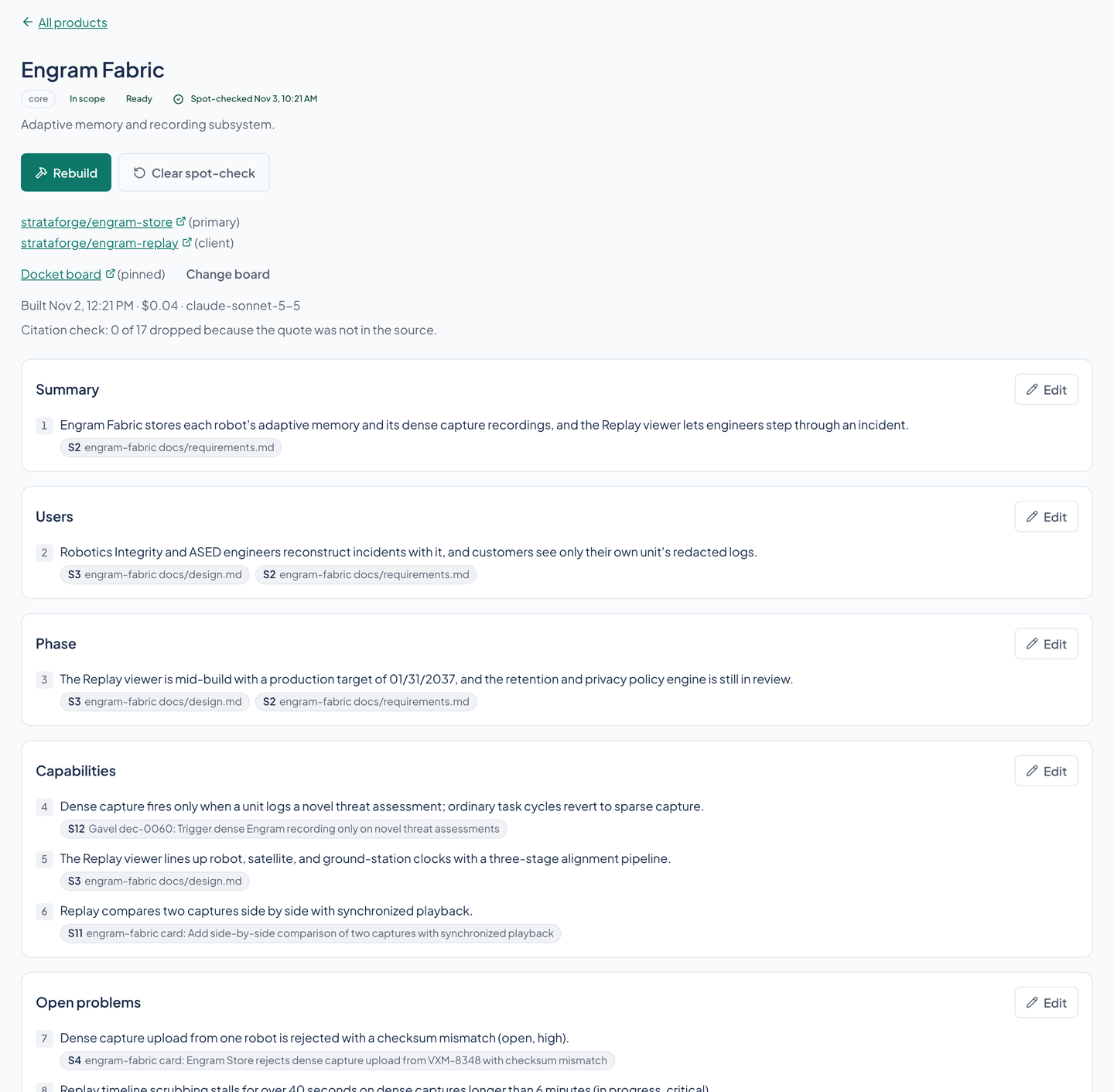
Each claim cites a source and quotes it. CARA drops any cite whose quote is not found in that source, ignoring case and spacing, and the product page says how many were dropped. The claims are numbered, so a conversation can cite them exactly.
Settled decisions, kept visible
Decisions that name the product's repository feed a Decided against section, so a question about a change meets what was already settled before it meets an idea.
Sources listed, gaps shown
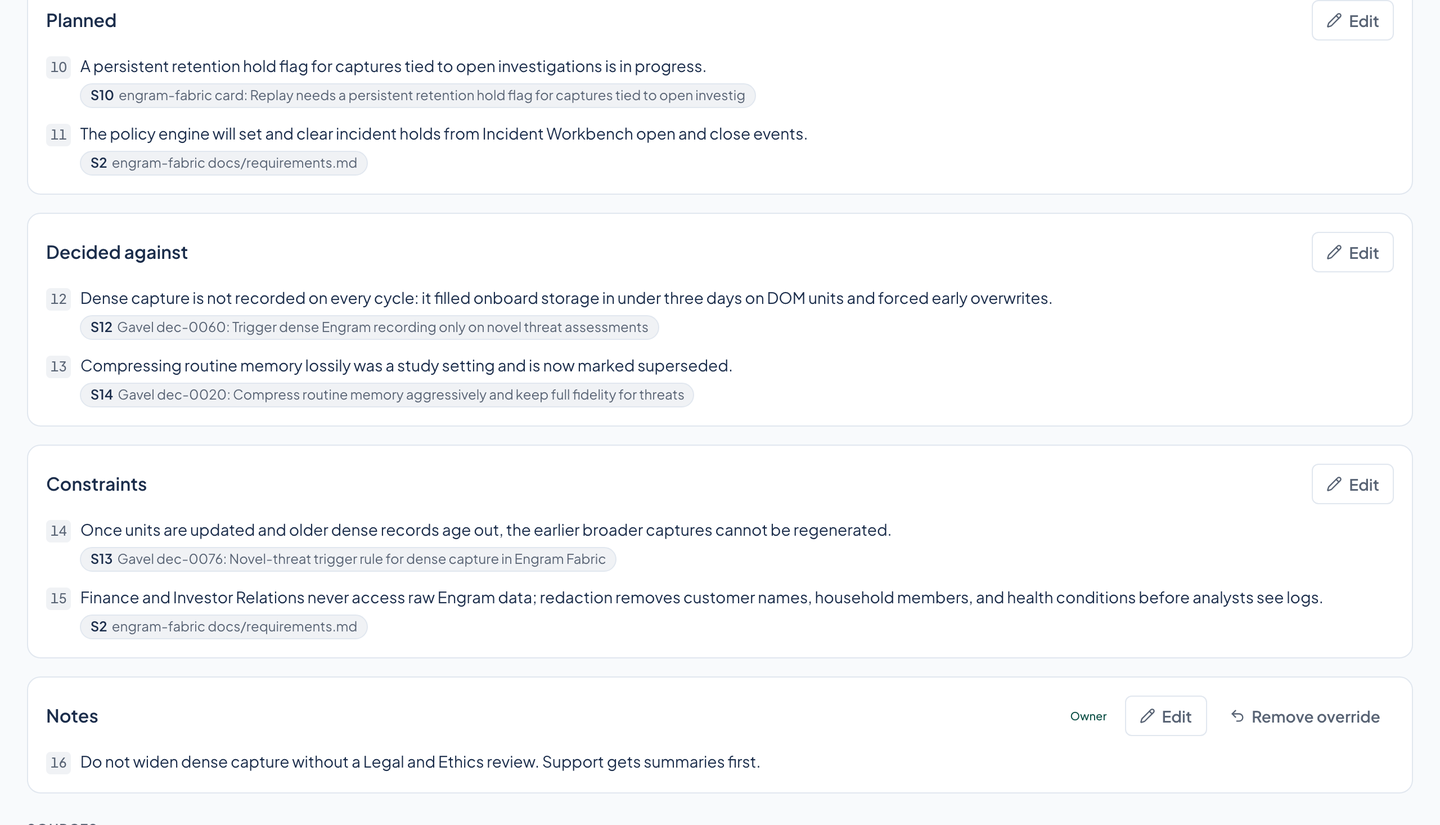
The source manifest shows every document, card, and decision a build read, and whether each document was read, is not in the repository, or could not be reached. A product with no design document says so.
- Rebuilds when sources change
- A scheduler check compares each product with its sources, documents within the hour and Docket and Gavel at most daily, and queues a rebuild when something changed. You can also rebuild one product, or build every product that has no profile. Three builds run at a time, and profile builds stop at a daily cap of $10.
You have the last word on a profile
Your words win
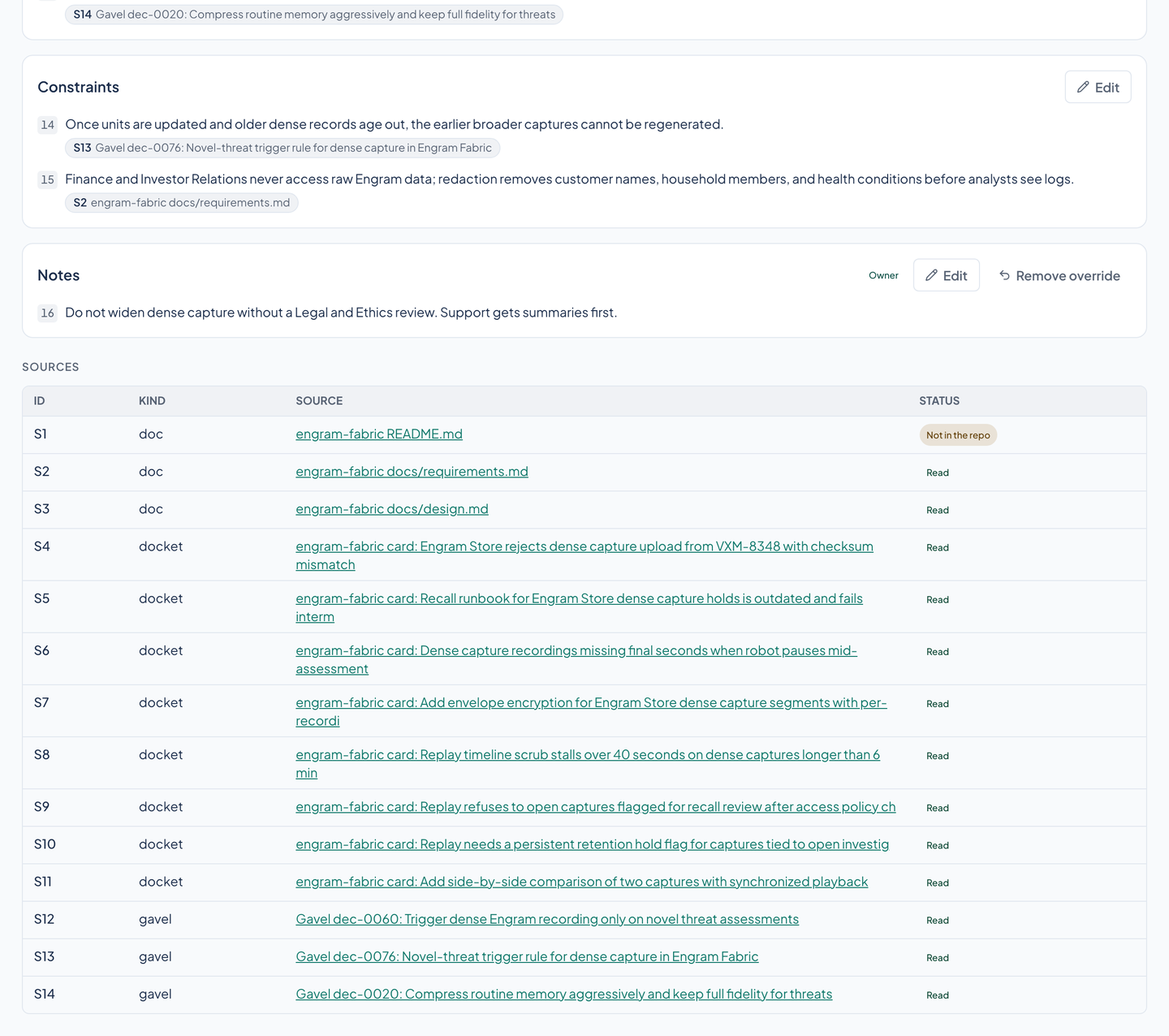
Edit any section of a profile and your text replaces the built claims, marked Owner. A rebuild keeps it, and in conversation CARA calls it your own words. Notes exist only as your own text.
Spot-check marks
Mark a profile spot-checked once you have read it. The mark and its date show in the list.
The scope mirror
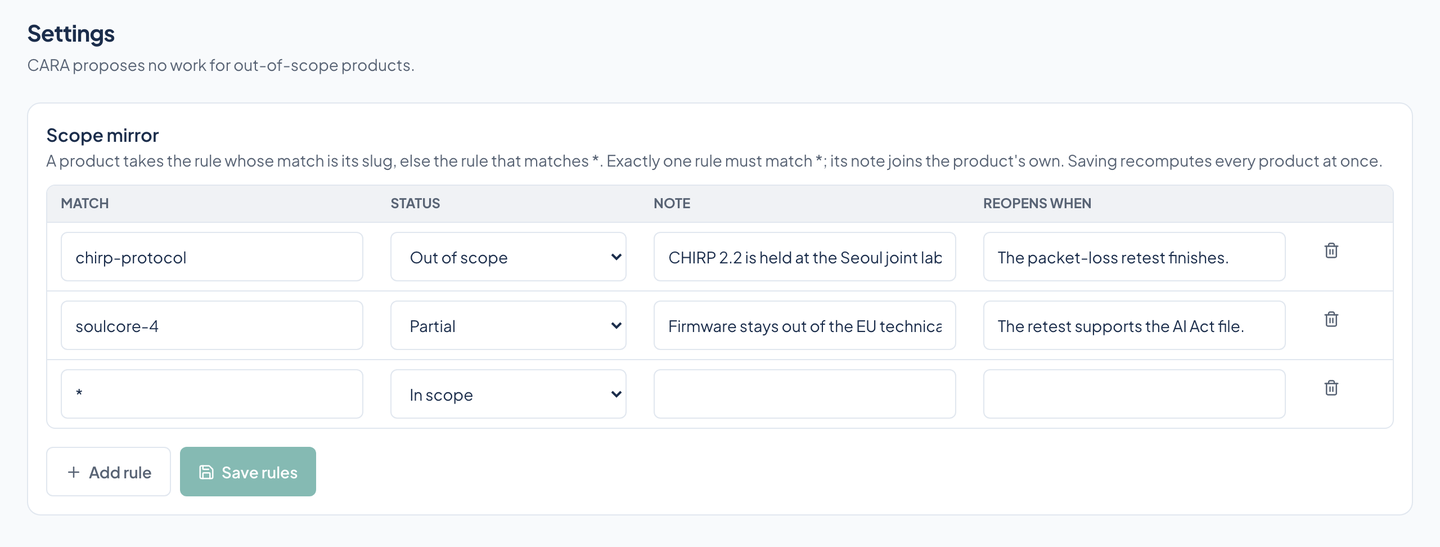
An ordered rule list says which products are in scope, partly in scope, or out, each rule with a note and when it reopens. A product takes the rule that names it, else the * rule, and saving recomputes every product at once. The advisor is told to propose no work for an out-of-scope product, and out-of-scope products are not rebuilt automatically.
- Pin a Docket board
- Pick the board a product reads. A pinned board is never replaced by a later name match.
From a repository map to a cited answer
Register
CARA reads the repository maps and keeps a registry of products with their repositories, kinds, and Docket boards.
Read
A build gathers the product's documents, its cards, and its decisions, all with read-only requests.
Check
The model writes numbered claims with quoted cites, and CARA drops every cite whose quote is not in its source.
Answer
A question brings in the profiles it names, and the reply's claim markers become links back to the sources.
Built so everyone can use CARA.
CARA's web app is built on the Renkara design system, its component tests find controls by role and label, and a scripted axe-core run covers every view in light and dark at phone and desktop widths. Here is what the product supports today and what we have actually checked. We do not claim a WCAG conformance level for the product.
Partly supported
Keyboard operation
Every control is a native link, button, or form field, so Tab reaches it. In a scripted walk of the Products page, 39 of 40 Tab stops showed a focus indicator (the other was the end of the page's tab order, not a control) and Enter on a product row opened it.
Partly supported
Screen reader landmarks and labels
axe-core, which checks names, labels, roles, and landmark structure, found no serious or critical violations in any view. CARA has not been tested with a screen reader.
Supported
Contrast in light and dark
Text and controls are checked for contrast in both the light and dark themes.
Not yet tested
Reduced motion
CARA's interface uses the Renkara design system's motion, which is designed to honor the reduced-motion setting. A scripted check found nothing animating on the Desk with or without the setting, but CARA's own tests do not exercise reduced motion.
Not yet tested
Text resize and zoom
Resizing text to 200 percent has not been tested.
Supported
Mobile and touch
Every view fits a 375 pixel and a 320 pixel wide screen with no sideways scrolling of the page; wide tables scroll inside their own labeled container. Most controls are 44 by 44 pixels or larger; inline citation numbers in a reply and the design system's brand link are smaller.
Under the hood
| Backend |
|
|---|---|
| Models and spend |
|
| Profiles |
|
| Web app |
|
| Tests |
|
| Stands in for | Re-reading every repository's docs before a planning conversation, Asking an assistant that has never seen the Docket board |
Questions people ask
Is CARA available to other teams?
No. CARA is internal to Renkara and is not offered for sale. This site shows what it does and how it is built. Write to fleet@renkara.com with questions.
Is it running in production?
No. CARA runs locally today and is not deployed, so everything on this site describes that local build.
Can it change my repositories, cards, or decisions?
No. A profile build reads GitHub, Docket, and Gavel with GET requests only, and the advisor in a conversation has no tools at all.
Can an answer be wrong?
Yes. A profile is a condensed summary of the product's sources as of the time it was built and may be out of date. CARA cites claim numbers so you can open the card, document, or decision behind each one. Read the source before you act on it.
Where does my text go?
Your messages, and the profiles they bring in, go to Anthropic's API to be answered. During a profile build the product's documents, cards, and decisions go to the API too. Conversations, profiles, and the spend ledger are kept in a local database.
Is the data in the screenshots real?
No. Every screenshot is a capture of the running app against a fictional portfolio for StrataForge Robotics, a made-up company. The profiles are rows written from fictional documents, cards, and decisions, after CARA's own cite check kept every quote, and the conversation replies are recorded text. No model was called and nothing was spent.
Questions about this tool?
Write to Renkara Media Group and a person will answer.